

Eight New Postdoctoral Commercialization Fellows to be Supported by MEDC T3N, EDA Global Epicenter for Mobility (GEM)
11/14/2025
Innovation Partnerships has announced the funding of eight Postdoctoral Commercialization Fellows, based on the strong commercialization potential of their doctoral research. This program is designed to provide these outstanding research scholars with the opportunity to further develop their innovations into marketable products and services.
The fellows will be supported by the Michigan Economic Development Corporation’s Technology Transfer Talent Network, or T3N, along with university matching contributions and support from the Global Epicenter of Mobility’s Mobility Acceleration Innovation Network, which is funded by the U.S. Economic Development Administration.
Each postdoctoral fellow will receive a stipend of up to $50,000 to further advance their research and help them move toward commercialization.
In addition to their funding, fellows will also receive support from a mentor-in-residence provided by the T3N and GEM program.
Awardees are selected for the postdoctoral commercialization fellowship by the Innovation Partnerships Ventures team. To be eligible for the fellowship, applicants must be a postdoctoral researcher from one of U-M’s three campuses and conducting research in an area that has strong commercialization potential. Applicants must also be nominated by their supervising principal investigator, with each applicant’s funding match committed prior to selection.
“The T3N program is a testament to Michigan’s commitment to research commercialization and economic impact,” said Kelly Sexton, associate vice president for research – innovation partnerships and economic impact. “It not only empowers the next generation of entrepreneurs, but also reinforces the state’s position as a national leader in translational research and innovation. I am delighted that we’re supporting the funding of eight outstanding fellows this year, each poised to bring groundbreaking discoveries closer to real-world impact.”
The fellows program has a proven track record of success creating economic and entrepreneurial growth. Notably, 11 previous Postdoctoral Commercialization Fellows have gone on to become startup CEOs, collectively raising more than $100 million, with over 80% of the companies continuing their ventures in Michigan.
From a competitive field of applications, the following recipients were chosen for a T3N or EDA postdoc commercialization fellowship:
 |
Ala’aldin Alafaghani
University of Michigan Mechanical Engineering; PI – Daniel Cooper Alafaghani is researching internal quenching of automotive hollow extrusions |
 |
Nikhil Divekar
University of Michigan Robotics; PI – Robert Gregg Divekar is developing a hybrid powered-unloading knee orthosis. |
 |
Hualong Liu
Electrical and Computer Engineering, University of Michigan – Dearborn; PIs – Wencong Su and Mengqi Wang Liu is creating a control-aware, co-design software for intelligent microgrid planning and deployment as part of the CtrlPlan Studio. |
 |
Katrina Munsterman
University of Michigan Ecology and Evolutionary Biology; PI Jacob Allgeier Munsterman is developing a business to build simple, durable and cost-effective artificial reefs. |
 |
Anna Park
University of Michigan Molecular and Integrative Physiology; PI – Jun Hee Lee Park is building upon Seq-Scope-X technology: integrating tissue expansion microscopy with advanced spatial barcoding. |
 |
Nasir Rahim
College of Innovation and Technology, University of Michigan-Flint; PI – Khalid M. Malik Rahim is developing a multiview, multimodal and neuro-symbolic decision support system for predicting intracranial aneurysm rupture risk using neuroimaging, |
 |
Brian Ross
University of Michigan Biomedical Engineering; PI – Lonnie Shea Ross is working on cell capture scaffolding technology. The startup for his project, Porosity Bio, participated in the first cohort of the Accelerate Blue Foundry. |
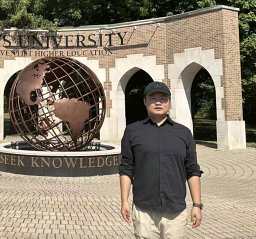 |
Chunlei (Karl) Song
University of Michigan Mechanical Engineering – PI; Albert Shih Song is developing an endoscopic microdiscectomy device for efficient cartilaginous endplate removal in lumbar fusion surgeries. |